
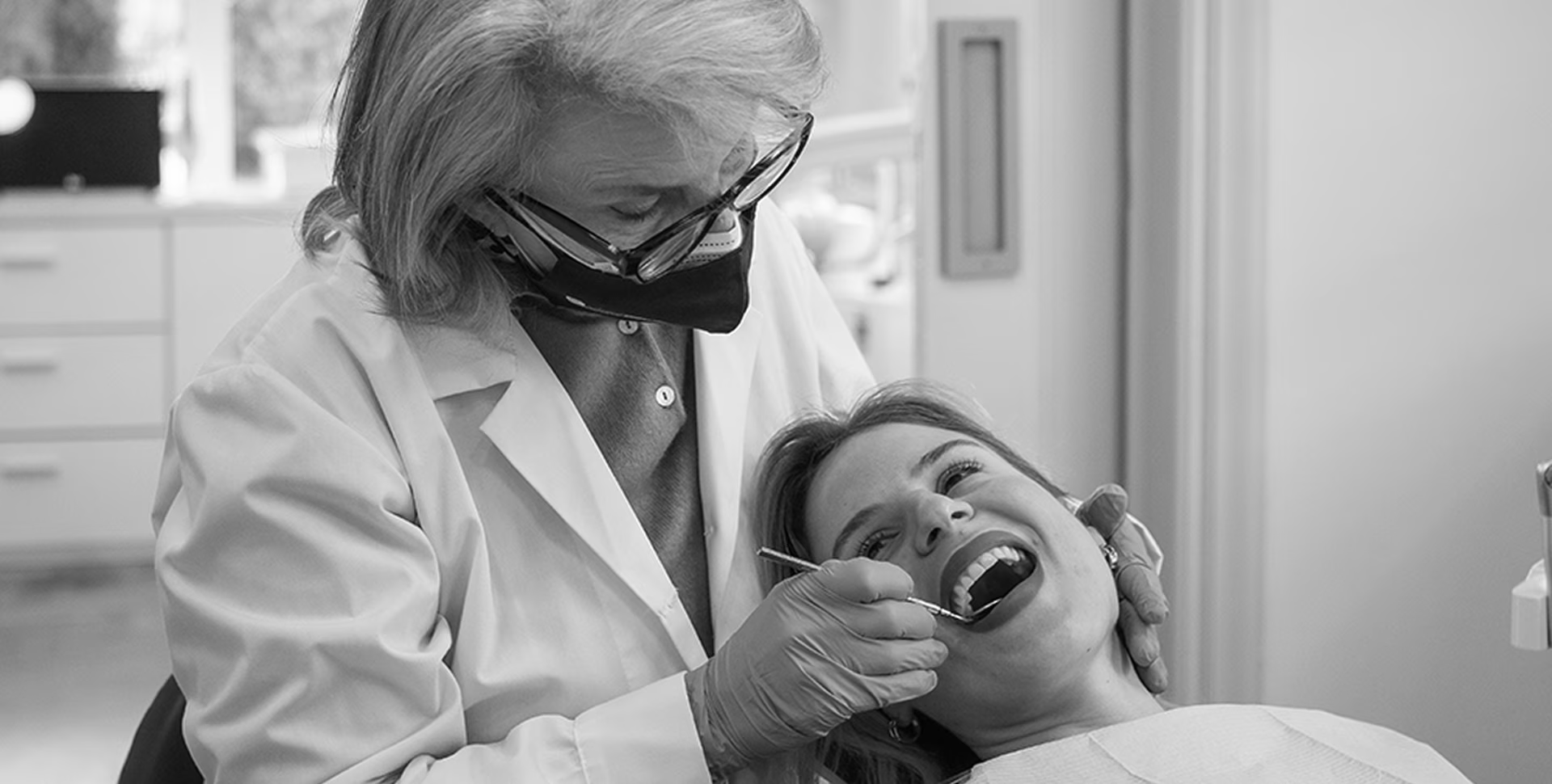
Lingual Braces
(Invisible Orthodontics)
INCOGNITO® lingual braces by 3M — placed on the inner side of the teeth. Full orthodontic treatment, completely invisible to others.
You want straight teeth, but you don't want anyone to notice you're wearing braces.
Maybe you work with people. Maybe you are in front of a camera. Maybe you simply don't want to become a topic of conversation for the next two years. Traditional braces do exactly that — they make you immediately visible. There is an alternative that doesn't.
THE SOLUTION
What lingual braces are and what makes them different.
Internal braces, also known as lingual braces, are a form of fixed orthodontic treatment where the brackets are placed on the inner side of the teeth. This way, treatment works like traditional braces but stays almost invisible to those around you.
This solution is particularly popular with adults who want to correct crooked teeth, crowding or bite problems without affecting their image at work, in social settings or in everyday life.
Completely invisible
Placed on the inner — lingual — side of the teeth. Your conversation partners see nothing, from any angle.
Customized for each tooth
With digital 3D impressions, each bracket and each wire are computer-designed exclusively for your mouth. No standardized components.
More comfortable than traditional lingual techniques
The INCOGNITO® system is designed for maximum comfort. Contact with the tongue is minimal and adaptation is quick.
Reduced treatment time
The precision of customized components translates to more effective movements and often shorter overall treatment.
Full orthodontic result
At the end of treatment: ideal restoration of upper and lower dental arches, correct occlusion, perfect orthodontic result.
WHY INCOGNITO® & WHY ATHENS DENTAL CARE
Technology alone is not enough. You also need the right orthodontist.
3M's INCOGNITO® is the leading digital lingual orthodontic technique, a true technological revolution compared to older lingual methods. But like any advanced tool, results depend on the experience of the one using it. At Athens Dental Care we are trained and certified in the INCOGNITO® technique, not just familiar with it.
HOW IT WORKS
Your plan in 3 steps.

1
Free first visit
We examine your case and explain whether lingual braces are the right choice for you. No commitment.

2
Treatment plan
Digital impression of your mouth, design of customized brackets and wires. You receive a clear proposal: duration, stages, cost. You decide.

3
Result
We execute with precision what we agreed on. Regular follow-up appointments, until the final result.
BEFORE & AFTER
Real patients, real results


Crowding
Correction of crowding (crooked teeth) & spacing (closing gap in front teeth)


Spacing
Closing gaps with orthodontic aligners & whitening


Deep bite
Correction of deep bite (lower teeth visible) & repositioning of posterior teeth (wider smile)


Midline shift
Correction of front teeth midline shift with orthodontics & veneers


Midline shift
Correction of teeth midline shift & deep bite correction (lower teeth visible)


Crowding
Correction of crowding (crooked teeth) after orthodontic treatment
Internal braces, or lingual braces, are braces placed on the inner side of the teeth. This way, they work as a fixed orthodontic treatment but aren't easily visible when you talk or smile.
Because they are placed behind the teeth, internal braces aren't visible to most people in everyday communication. That's why they're a popular choice for adults who want orthodontic treatment without visible braces.
The main difference is their position. Traditional braces are placed on the front of the teeth, while internal braces are placed on the back. Both are fixed orthodontic treatments, but internal braces are far more discreet.
Not always. Suitability depends on the position of the teeth, the bite, oral hygiene, the patient's needs and the difficulty of the case. The orthodontist will assess whether internal braces are the right choice or whether another form of orthodontic treatment is a better fit.
Fitting isn't painful, but during the first days there may be pressure on the teeth or irritation of the tongue, because the brackets are on the inner side. The patient usually adapts gradually over the first days or weeks.
At first there may be a slight change in speech, mainly because the tongue comes into contact with the braces. In most cases, speech improves as the patient gets used to the new position of the brackets.
The duration depends on the difficulty of the case, the bite and the treatment plan. In some cases it may last a few months, while in more complex cases it may take longer. An estimate is given after the orthodontic assessment.
Internal braces usually cost more than traditional metal braces, because they require custom design, a special technique and greater expertise to apply. The final cost depends on the duration and difficulty of the treatment.
With internal braces you need to be careful with very hard, sticky or crunchy foods, just as with traditional braces. The orthodontist will give you specific instructions on diet and tooth care during treatment.
Cleaning requires care, because the brackets are on the inner side of the teeth. Thorough brushing, interdental brushes or special cleaning tools are usually needed to maintain good oral hygiene throughout treatment.
There is no single best option for everyone. Internal braces are fixed and don't depend on the patient remembering to wear them, while clear aligners are removable and more practical for eating and brushing. The choice depends on the case, daily life and the plan the orthodontist recommends.
Yes. After treatment is completed, a retainer or another retention device is usually needed to maintain the result and prevent the teeth from moving again.

We explain whether lingual braces suit your case, how long the treatment will take and what it costs. You decide if and when to start.