
Invisible
orthodontic care,
visible results.
Invisible orthodontics with clear aligners
without braces, without embarrassment,
without compromises in your daily life.
You know your smile can be better. But the idea of wearing braces stops you.
Maybe you feel you have "passed the age". Maybe you worry about how you will look at work or in your social life. Maybe you simply don't know if it is feasible for your case. You don't need to already have answers to your questions — that's what the free first visit is for.
THE SOLUTION
What invisible orthodontics is and how it works.
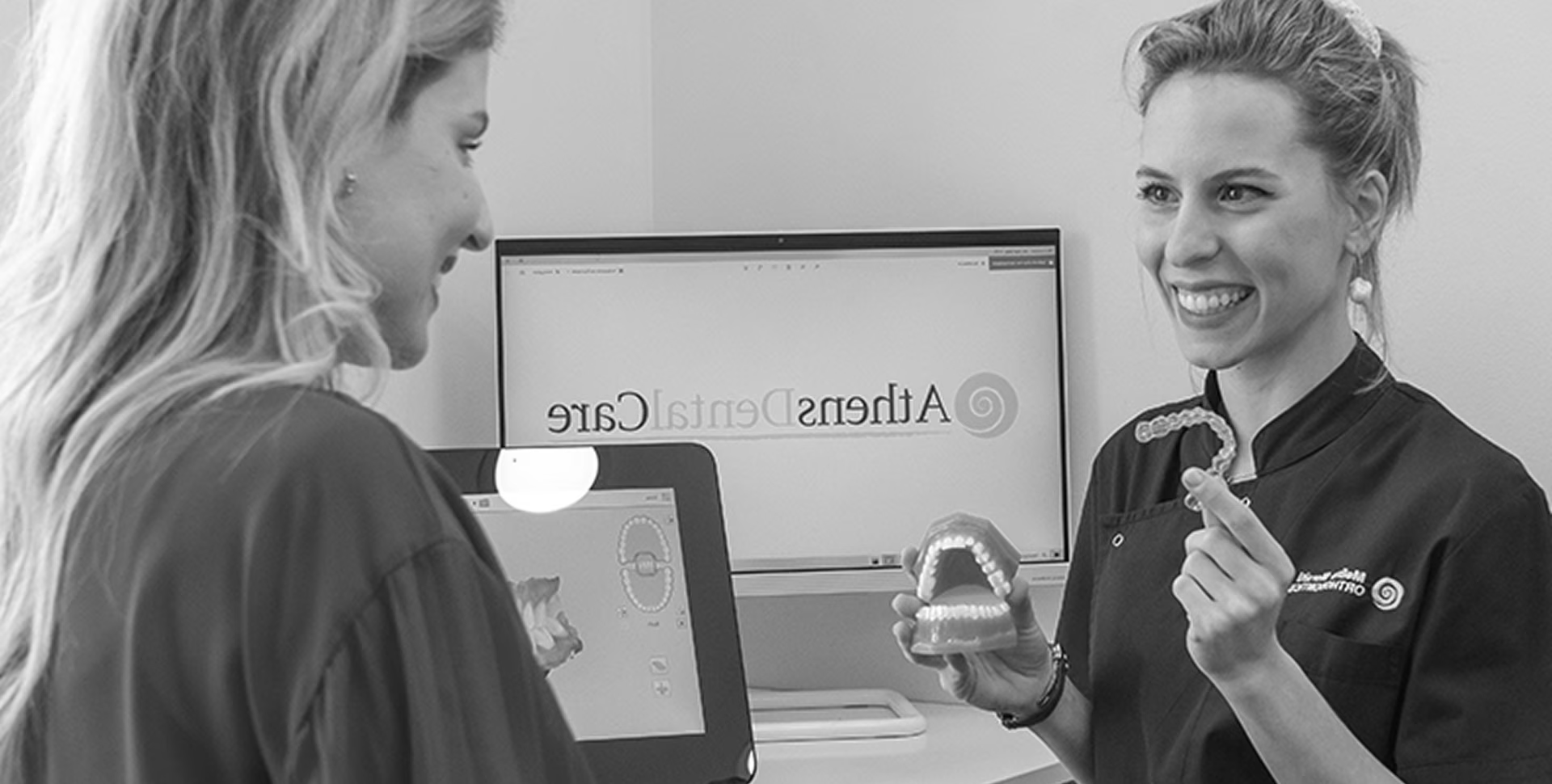
Invisible orthodontics uses clear, custom aligners that fit on your teeth and gradually move them to the correct position. You change aligners every week. Nobody notices you are doing orthodontics.
Invisible
Made from clear hypoallergenic acrylic. Feel comfortable with your appearance.
Removable
You take them out for eating and brushing. No dietary restrictions, no impact on oral hygiene.
Comfortable
They don’t injure lips and gums. Slight sensitivity for the first 2-3 days of each new stage, which is a normal sign that the treatment is progressing.
Time-flexible
Treatment can last from 2-3 months to 2 years, depending on your case.
Find out if it is right for you
WHY INVISALIGN & WHY ATHENS DENTAL CARE
Not all aligners are the same. And not all orthodontists are the same.
Many clear aligner companies are on the market with different capabilities. Invisalign has been the global leader since 1990, with now unlimited capabilities for a perfect orthodontic result — both aesthetic and functional.
We are Invisalign Diamond Providers — the highest certification title, awarded for volume of successful treatments.
Dr. Pablo Lirio is an official Invisalign Speaker for all of Europe, training other orthodontists in the technique.
We also work with the Spark, Angel & Clear Aligner systems, for every case.

Low cost elsewhere may mean problematic treatment and starting over from scratch. Orthodontics is not just "straightening" teeth — it involves occlusion, jaw position, proper articulation. Choose carefully.
HOW IT WORKS
Three steps. No surprises.

1
Free first visit
Clinical examination, photos, X-rays, digital impressions. We discuss what you want to change and explain what is achievable.

2
Treatment plan
You receive a clear written proposal: which method, how many stages, how long it takes, what it costs. You decide if and when to start.

3
Result
You receive your aligners and change them every week. Regular follow-up appointments, until the smile we were aiming for.
BEFORE & AFTER
Real patients, real results


Crowding
Correction of crowding (crooked teeth) & spacing (closing gap in front teeth)


Spacing
Closing gaps with orthodontic aligners & whitening


Deep bite
Correction of deep bite (lower teeth visible) & repositioning of posterior teeth (wider smile)


Midline shift
Correction of front teeth midline shift with orthodontics & veneers


Midline shift
Correction of teeth midline shift & deep bite correction (lower teeth visible)


Crowding
Correction of crowding (crooked teeth) after orthodontic treatment
FAQ
Frequently asked questions
22 hours a day. They are removed only for eating and brushing.
From 2-3 months to 2 years, depending on the orthodontic irregularity and cooperation.
Slight sensitivity for 1-2 days with each new aligner — normal and temporary.
Yes. You remove the aligners to eat, so there are no dietary restrictions.
A slight lisp for 1-2 days at the beginning — it goes away as you get used to it.
You notify the doctor immediately — there is a solution, usually with the previous or next aligner, or ordering a new one.
NO. Gum will stick to the aligners. We recommend removing your aligners for all meals and snacks.
We discourage tobacco use while wearing the aligners, as they may become discoloured.
It's normal to have small mismatches between the new aligner and the current position of the tooth, as teeth need time to adapt to the aligner's new position. If significant problems arise with the fit of the aligner, inform your doctor.
Depending on the specific treatment you're following, some of the movements may require the use of 'attachments', so that the aligner can hold the teeth. These bumps or wells are the points where the aligner grips the attachment your doctor places on your teeth. Attachments are usually small pieces of resin (the material used for white fillings) that the orthodontist places on your teeth. These attachments are held in place by the bumps on your aligners. The grooves are thin recesses in your aligners. Your doctor will use one or both of these features to achieve the desired movement.
If you lose or break an aligner, you should inform your doctor immediately. Your doctor will likely advise you to start wearing the previous or next set of aligners right away. They may order a new set of aligners to replace the one you lost, which will be delivered to you within a few days.
If you lose or break an attachment, you should inform your doctor immediately.

The decision is yours
We explain whether invisible orthodontics suits your case, how long it will take and what it costs. You decide if and when to start.